§ A Prototype Over the Runway
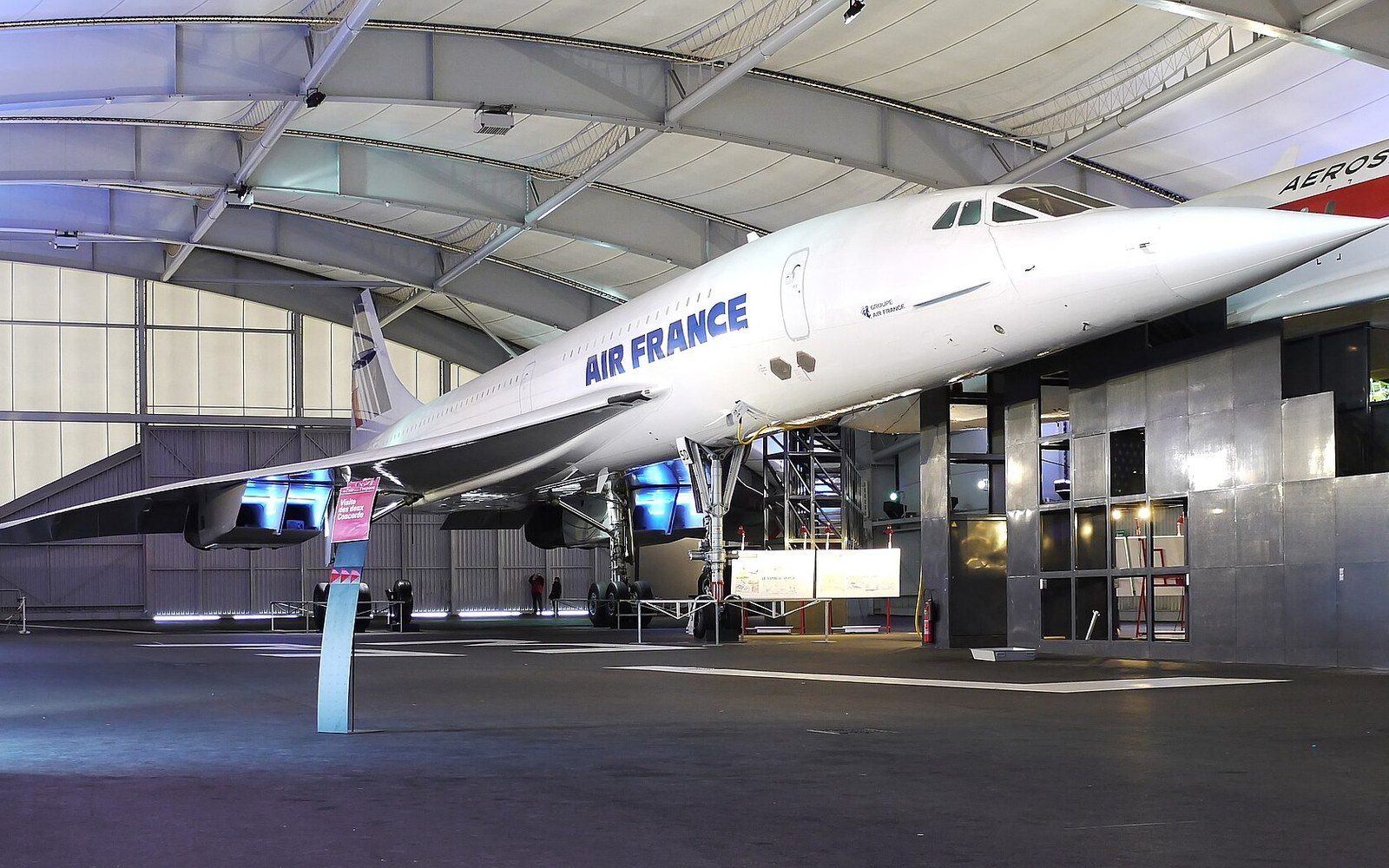
Concorde 001, the French-assembled prototype built at Aérospatiale's Toulouse facility, made its first flight on 2 March 1969. By June of that year it was at Le Bourget, performing its first public flying display at the Paris Air Show — less than four months after that maiden flight. The aircraft that appeared was not a production machine but a working prototype, unpainted except for the tricolour roundels and the registration F-WTSS. Its presence at the show confirmed that the Anglo-French programme, launched by treaty in November 1962, had produced a flying aircraft.
The display was brief by later standards. Test pilot André Turcat, who had commanded the 2 March flight, handled the aircraft at Le Bourget. The performance demonstrated the delta wing planform and the drooping nose — lowered for landing visibility and raised for cruise — that would become Concorde's most recognisable features. Crowds and industry visitors saw a slender aircraft with four Olympus 593 turbojet engines, developed jointly by Rolls-Royce and SNECMA, capable of sustaining supersonic cruise above Mach 2. At altitude that translated to roughly 2,180 kilometres per hour — twice the speed of sound at cruise conditions.
The appearance at the 1969 show was a diplomatic as much as a technical event. Britain and France had spent seven years and mounting costs developing an aircraft that no airline had yet committed to buying in firm numbers. A public flight at the world's leading air show was the clearest possible demonstration that the investment had produced results. Air France and British Overseas Airways Corporation held options; the manufacturers needed to hold their nerve and their governments' patience. Le Bourget, with its concentration of airline buyers, military procurement officers and international press, was the right arena.
Chronology
From the record- 2 March 1969Concorde 001 makes its maiden flight from Toulouse
- June 1969first public flying display, Paris Air Show, Le Bourget; pilot André Turcat
- June 1969Tupolev Tu-144 flies faster than sound for the first time, months before Concorde does
- 3 June 1973Tu-144 crashes at Le Bourget during flying display; 6 crew, 8 ground fatalities
- January 1976Concorde enters commercial service with Air France and British Airways
- October 2003Concorde withdrawn from service after 27 years of passenger operations
§ The Show That Followed, and What It Cost
Four years on, the 1973 Paris Air Show at Le Bourget supplied the counterpoint. The Soviet Tupolev Tu-144 — the aircraft that had beaten Concorde to a first supersonic passenger flight by two months, in December 1968 — was performing a flying display on 3 June 1973 when it broke apart over the town of Goussainville, north of the airfield. All six crew members aboard died, along with eight people on the ground. The crash of the Tu-144 at Le Bourget remains the worst accident in the history of the Paris Air Show.
The causes were investigated but never definitively published by Soviet authorities. What the disaster did was frame supersonic civil aviation in a different register. Concorde was by then approaching production standard — the type entered service with Air France and British Airways in January 1976 — but the spectacle of a supersonic airliner disintegrating over a French suburb, witnessed by the show's entire crowd, was an image that attached itself to the programme regardless of the aircraft involved.
Le Bourget had been the stage for both moments: the optimistic debut of 1969 and the catastrophic afternoon of 1973. The airfield itself, established as an aviation site before the First World War and formalised as the home of the Paris Air Show through successive editions from 1953 onward, carried both events in its record without editorial comment. It was a venue that simply exposed what was flying.
Concorde 001 was retired in 1973 after a test programme of 397 flights. The production aircraft that followed it carried passengers on transatlantic routes for twenty-seven years, until the type's withdrawal from service in October 2003. The 1969 display at Le Bourget stands as the moment the public version of that story began — before the orders, the delays, the oil crisis economics and the eventual narrow triumph of getting the aircraft into commercial service at all.
 Plate 02