§ From the Grand Palais to the Grass
The first Salon de l'Aéronautique opened in December 1909 at the Grand Palais on the Champs-Élysées, less than a year after Louis Blériot's Channel crossing had made aviation a public obsession. Hundreds of exhibitors showed airframes and engines in the nave. The machines were still fragile enough to carry indoors without dismantling, and the Grand Palais, with its vast glazed vault, was the natural heir to the Exposition Universelle tradition of sheltering spectacle beneath iron and glass.
Le Bourget, about ten kilometres north of the city centre, was only developed as an airfield from 1914. The French military formalised it as an aerodrome during the First World War, and in 1919 it became the terminus for the first scheduled international air service, the London–Paris route operated by Aircraft Transport and Travel. Charles Lindbergh landed there in May 1927 at the end of the first solo transatlantic flight, to a crowd the French press reported at around 150,000. That accumulation of firsts gave Le Bourget a historical weight no purpose-built exhibition field could replicate.
The air show — renamed the Paris Air Show, or Salon International de l'Aéronautique et de l'Espace — moved permanently to Le Bourget after the Second World War, settling into a biennial rhythm on odd-numbered years. The logic was practical: aircraft had grown too large and too fast to display meaningfully indoors. Flying displays required runways. Le Bourget had both, along with hangars that could absorb static exhibits during the week-long event.
Chronology
From the record- 1909First Salon de l'Aéronautique, Grand Palais, Paris
- 1919Le Bourget opens as terminus for London–Paris scheduled service
- 1927Lindbergh lands at Le Bourget after first solo transatlantic crossing
- Post-1945show moves permanently to Le Bourget, biennial odd-year schedule established
§ The Aerodrome as Exhibition Ground
The site's dual identity — working airport through the 1970s and periodic fairground — created an unusual spatial discipline. The static display area runs along the northern edge of the runway complex, where aircraft park in a long curved line accessible to trade visitors and the public from separate enclosures. The separation is deliberate: the show operates simultaneously as a trade fair for aerospace procurement and as a public spectacle, and the two audiences see versions of the same hardware from different distances and with different briefings.
The chalet zone, a row of temporary hospitality and meeting structures erected by manufacturers and national aerospace agencies along the flight line, is as much a part of the show's architecture as the hangars. Some chalets are rebuilt to the same footprint edition after edition; others are redesigned to carry new product launches. Airbus and its predecessor companies have held press conferences in these structures since the 1970s, announcing orders and specifications to journalists seated within earshot of the runway.
Flying displays are scheduled across the central hours of each day. The display zone is defined by a hard boundary — an axis the pilots must not cross toward the public enclosure — a constraint that has shaped how manufacturers design demonstration manoeuvres. It is this boundary, and the density of the crowd behind it, that makes Le Bourget categorically different from a static trade fair: the product is actually operating, overhead, for minutes at a time, in conditions close to its designed limits.
§ The Site's Longest Continuity
The aerodrome buildings that face the public enclosure date partly from the interwar period and include the terminal completed in 1937, now part of the Musée de l'Air et de l'Espace, which occupies the original passenger buildings. Between shows, the museum's permanent collection of aircraft and space hardware — among them a Concorde prototype — occupies halls that during the biennial event become overflow static-display space.
That layering — an active show site, a history museum, a functioning logistics hub for business aviation — gives Le Bourget a density of use that no single-purpose fairground achieves. The Paris Air Show does not occupy neutral ground. It occupies a field that already carries the weight of a century of flight, and each edition adds another numbered year to a sequence that began when most aircraft were still made of wood and linen.
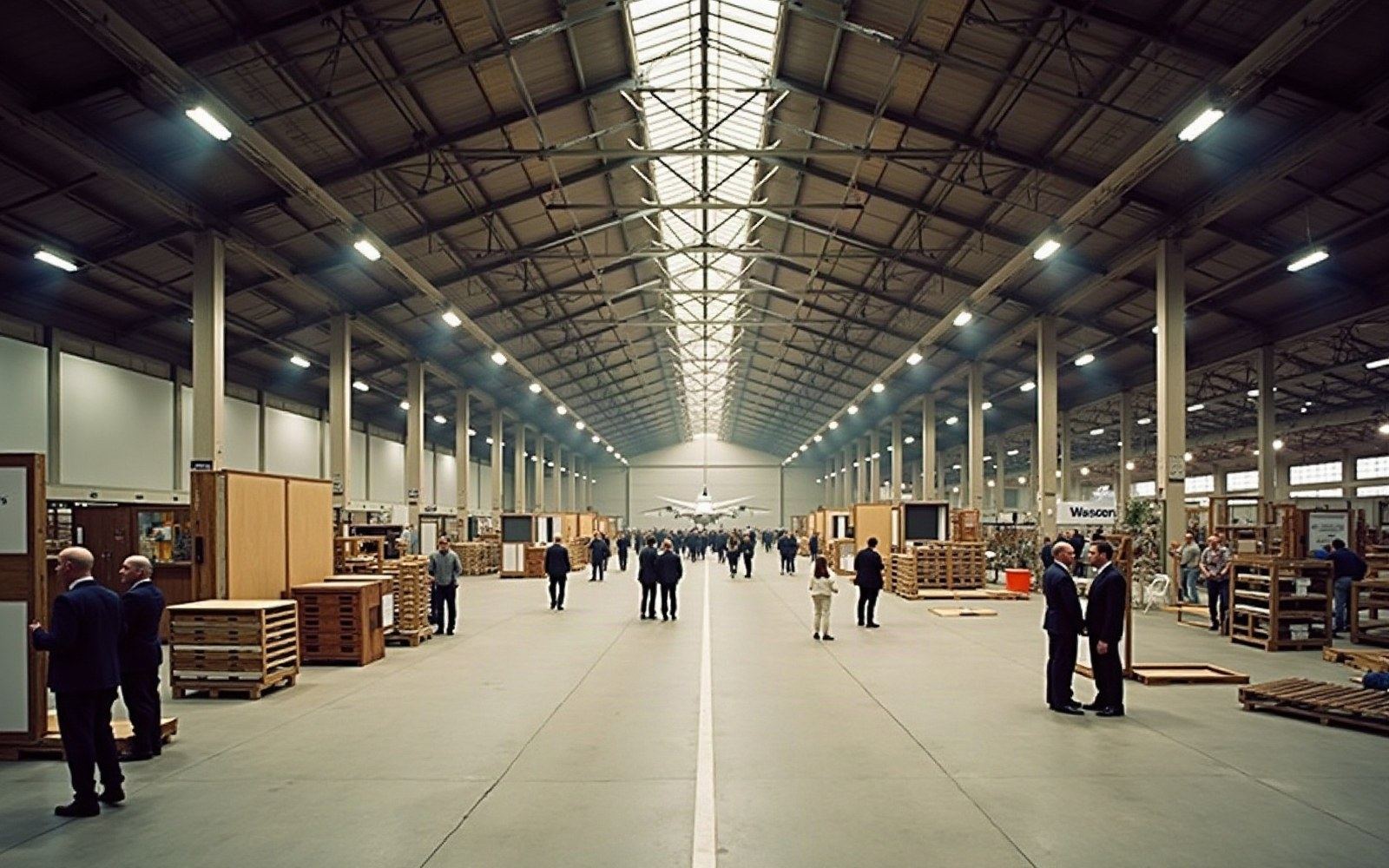 Plate 02