§ The Site Remade, Again
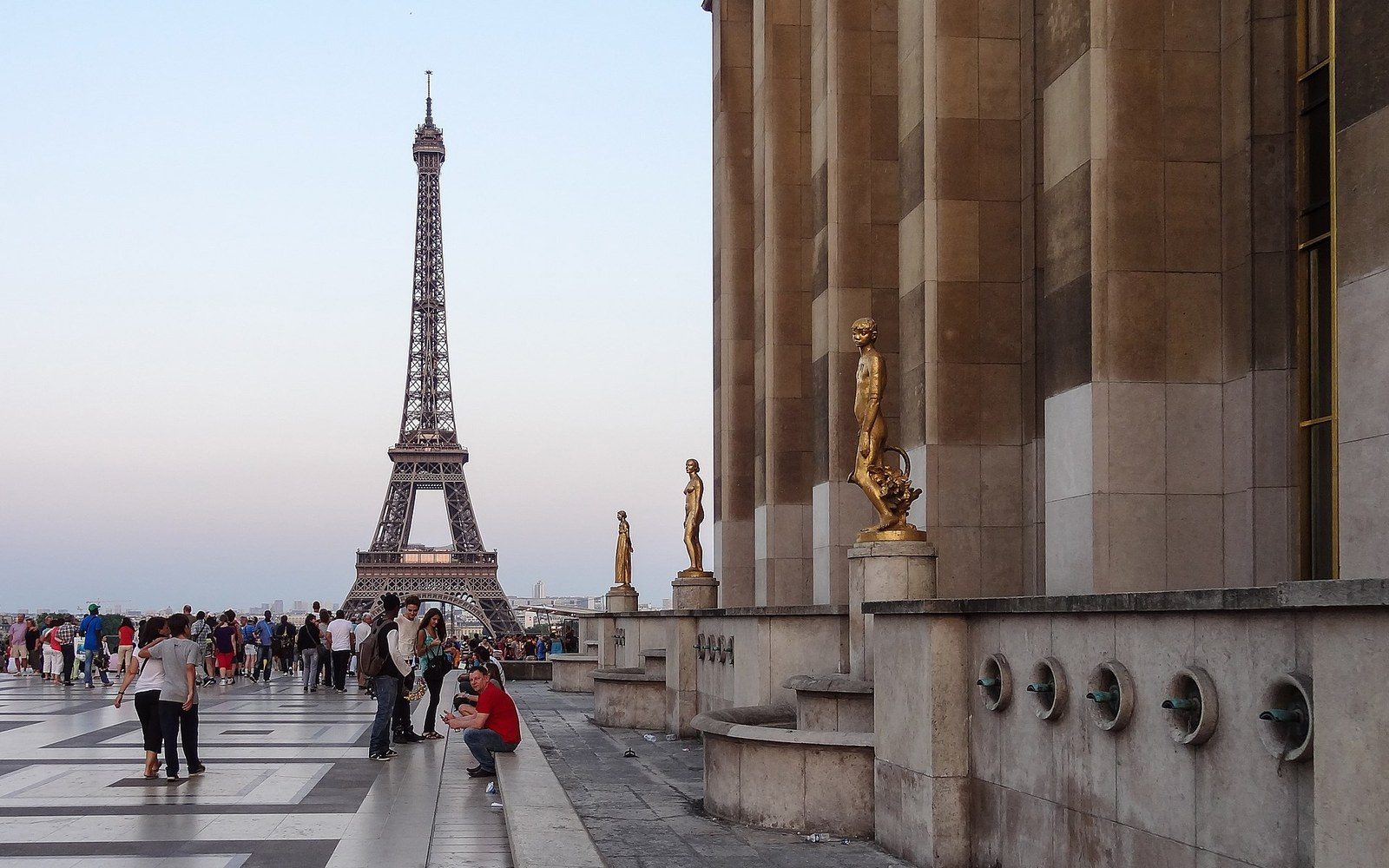
The Exposition internationale des Arts et Techniques dans la Vie moderne opened on 25 May 1937 on a site Paris had already transformed three times: the Champ de Mars and the Trocadéro hill, reshaped for the expositions of 1867, 1878 and 1900. The 1937 event demanded another cycle of demolition and construction. The old Palais du Trocadéro, a horseshoe auditorium built in 1878, came down to make way for the Palais de Chaillot, designed by architects Louis-Hippolyte Boileau, Jacques Carlu and Léon Azéma. Its two curved wings — clad in tawny stone and set with gilt inscriptions — frame an open terrace looking directly across the river toward the Eiffel Tower. No central dome closes the space: the gap is deliberate, a theatrical axis.
On the same bank, the Palais de Tokyo rose simultaneously along the Avenue du Président Wilson, designed by Jean-Claude Dondel, André Aubert, Paul Viard and Marcel Dastugue. Both palaces were conceived as permanent cultural institutions from the outset — the Palais de Chaillot to house several national museums, the Palais de Tokyo for the collections of modern art that had been accumulating since the 1930s. Neither was fully finished when the exposition opened, and both have been in near-continuous institutional transit ever since.
§ Delaunay's Colour on an Industrial Scale
The 1937 exposition was unusual in the scale of its mural commissions. Robert Delaunay, working with his wife and collaborator Sonia Delaunay, produced paintings for two of the largest interiors: the Palais de l'Air and the Palais des Chemins de Fer. For the Palais de l'Air, Delaunay painted a sequence of large discs in his signature simultanisme — interlocking rings of colour derived from his long investigation into chromatic contrast. The work ran across hundreds of square metres of wall and ceiling surface, integrating propeller forms and aviation imagery into a scheme of pure optical energy. For the railway palace, a complementary mural deployed similarly expansive colour fields, this time incorporating locomotive silhouettes. Both palaces were temporary structures; neither mural survived the exposition's close. What remains is photographic documentation and the studies held in French public collections.
Chronology
From the record- 25 May 1937Exposition internationale opens (delayed from its scheduled 1 May date)
- 26 April 1937Bombing of Guernica by German and Italian aircraft
- 25 May 1937Exposition internationale opens (delayed from its scheduled 1 May date)
- Early June 1937Guernica completed in Picasso's rue des Grands-Augustins studio
- 1992Guernica installed permanently at the Museo Reina Sofía, Madrid
§ Guernica in a Building It Was Never Quite at Home In
The Spanish Republican government commissioned a national pavilion, designed by the architects Josep Lluís Sert and Luis Lacasa, and sited on the rue de Longchamp at the northern edge of the exposition grounds — not on the principal riverside axis, but given a modest plot that the Republic's diminishing diplomatic standing partly explains. The building was simple: a steel-framed, glass-walled structure of three floors, provisional in character, built fast. Picasso had accepted the mural commission in January 1937, before he had any composition in mind. The bombing of Guernica by German and Italian aircraft on 26 April 1937, during the Spanish Civil War, supplied it: he completed the large canvas — 349 by 776 centimetres, oil on canvas, painted in grisaille — in his studio on the rue des Grands-Augustins by early June 1937. It was installed in the Spanish pavilion and shown there for the exposition's duration, hanging at the back of the ground floor, large enough to fill the wall but separated from visitors by a glass barrier that Picasso himself requested.
The pavilion also showed work by Joan Miró, Alexander Calder's mercury fountain and photographs documenting the war. At the exposition's close, Guernica left Paris with its owner — Picasso refused to allow it to return to Spain under Franco — and passed through decades of storage and loan, arriving at the Museo Reina Sofía in Madrid in 1992. The pavilion was demolished when the exposition closed; the Palais de Chaillot and Palais de Tokyo remained.