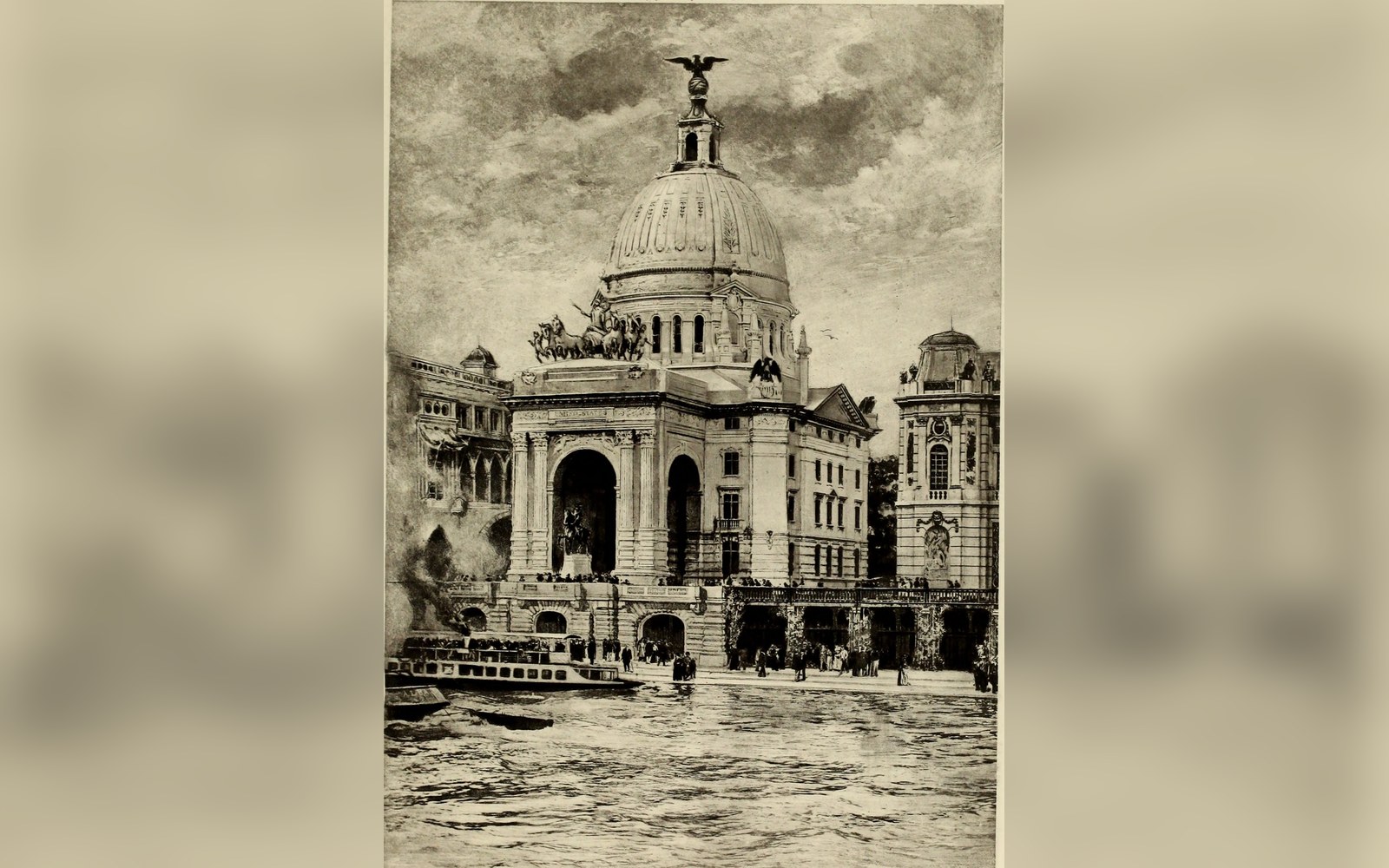
§ What the Organisers Recorded, and How
The five Paris Expositions Universelles held between 1855 and 1900 generated some of the most-cited numbers in the history of public spectacle. They appear in retrospective registers, government reports and the records of the Bureau International des Expositions, which was established by the 1928 Paris Convention and subsequently compiled attendance data from earlier events drawing on the organisers' own closing accounts. The BIE's figures are the standard reference, but they carry a proviso worth stating plainly at the outset: for any exposition held before the BIE existed, the number originates with the organising body itself — a committee with a direct interest in the scale of the result.
The 1855 Exposition Universelle, held in the Palais de l'Industrie on the Champs-Élysées, recorded approximately 5.1 million visits over its six-month run from May to November. That figure comes from the Commission Impériale's closing report, submitted to Napoleon III's government. Entry was not free: the tiered pricing structure — higher admission on certain days, reduced rates on others — meant that ticket stubs formed the basis of the count. A stub-based count is at least consistent, but it conflates repeat visitors with first-time arrivals, since the same person holding a season pass generated a different paper trail than someone paying daily. The Commission did not standardise for this, and neither did its successors, which makes cross-exposition comparison more treacherous than the headline numbers suggest.
By 1867, when the Exposition Universelle spread across the Champ de Mars in an enormous elliptical building designed by Frédéric Le Play's commission, the claimed total had risen to approximately 6.8 million. The Commission Impériale for 1867 again furnished the count, again from ticketing receipts. The 1867 exposition introduced a more elaborate pricing calendar than its predecessor, with free days for workers built into the schedule — a deliberate policy decision by the organising committee, partly to demonstrate the exposition's popular reach and partly to satisfy a political expectation that the event not be purely bourgeois. Free-day admissions were recorded by turnstile in some areas and by crowd-estimate in others, and the two methods were subsequently aggregated into a single total without clear annotation in the surviving record.
The five figures at a glance
From the record- 1855approximately 5.1 million visits; source: Commission Impériale closing report, ticket-stub basis
- 1867approximately 6.8 million visits; source: Commission Impériale closing report, ticketing receipts with partial crowd-estimate supplementation on free days
- 1878approximately 16 million visits; source: organising commission published account, mixed methodology, acknowledged margin of uncertainty
- 1889approximately 32.3 million visits; source: commission ticketing records, cited by BIE; separate tower-ascent receipts not included
- 1900approximately 50.8 million visits; source: commission turnstile-and-receipt system, cited by BIE as highest Paris exposition total
The gap between 1867 and 1878 brought the Franco-Prussian War, the Commune and a decade of reconstruction. The 1878 Exposition Universelle, mounted partly as an assertion of the Third Republic's recovery, claimed approximately 16 million visits — a figure that more than doubled the 1867 total and that contemporaries noted with some astonishment. The organizing commission attributed the jump partly to the extended run of the event, partly to expanded rail access from the provinces and from Britain, and partly to reduced entry prices relative to earlier editions. It is also the figure that most historians flag as methodologically weakest: the 1878 commission's counting regime combined paid-ticket tallies at main gates with separate counts at subsidiary entrances that were not always manned by the same personnel under the same instructions. The aggregated total from the commission's own published account, referenced by the BIE in its historical database, therefore includes an acknowledged margin of uncertainty that the headline number does not advertise.
§ The 1889 and 1900 Figures: Better Systems, Still Contested
The Exposition Universelle of 1889 produced the most famous structure in the French exposition tradition — the Eiffel Tower — and a visitor figure of approximately 32.3 million, drawn from the commission's ticketing records and cited by the BIE. The 1889 event ran from May to October, and its counting apparatus was more systematic than any predecessor's. The Eiffel Tower itself was ticketed separately from the general grounds, which meant the commission held two overlapping data sets: ground-admission receipts and tower-ascent receipts. The 32.3 million figure refers to ground admissions; it does not represent unique individuals, and a visitor who entered on six consecutive days contributed six units to the total. The commission was aware of this. Its published report distinguished between total admissions and estimated unique visitors — a number it placed considerably lower — but the larger figure entered the public record and has remained the standard citation.
Admission pricing at the 1889 exposition was also varied by day and gate, with reduced rates on Sundays and for professional groups attending specific congresses. The commission's account, preserved in the Archives nationales, records these categories separately before consolidating them into the single total. That consolidation is where precision dissolves: the sub-totals do not always reconcile cleanly, a discrepancy that researchers examining the primary record have noted without being able to resolve it definitively.

The 1900 Exposition Universelle — which remade the banks of the Seine, produced the Grand Palais and the Petit Palais, and introduced the trottoir roulant (the moving pavement that carried visitors across the Champ de Mars) — claimed approximately 50.8 million visits across its seven-month run from April to November. The BIE cites this as the highest attendance recorded for any exposition in Paris. The organising commission, operating under the Comité des Expositions de Paris and reporting to the Ministry of Commerce, used a purpose-built turnstile system installed at all main and subsidiary entrances, with daily reconciliation of mechanical counts against ticket receipts. It was the most rigorous methodology applied to any of the five events.
Even so, the 50.8 million figure carries interpretive weight that the method alone cannot settle. The 1900 exposition encompassed an area on both banks of the Seine, with visitors moving between zones through gates that were not all monitored with equal consistency. Internal zone-transfer passages added further ambiguity. The commission's own published closing report, issued in 1903, noted that the gate-count methodology was designed to count admissions rather than persons, a distinction it flagged in a footnote that subsequent secondary literature has not always preserved. The BIE's historical records reproduce the commission's figure as the official total, which is the right institutional response — the organiser's published account is the primary source — while making clear that cross-event comparison requires caution.
§ The Figure as Historical Claim
What the five numbers collectively demonstrate is less a graph of rising popularity than an evolution in the politics of measurement. The 1855 and 1867 commissions counted because they were required to report to the imperial government; the 1878 commission counted under the pressure of a republic that needed proof of national resilience; the 1889 commission counted with one eye on the competitive record set by London's 1851 Crystal Palace exposition; and the 1900 commission counted under a methodology sophisticated enough to be taken seriously, though still not designed to distinguish a single visitor's tenth admission from ten visitors' first.
None of this diminishes the scale of what the expositions achieved. Even allowing for generous double-counting, 50 million gate-recordings across seven months at a single site in a city whose population then stood below four million represents a logistical and cultural event of extraordinary magnitude. What it means, precisely, depends on which questions the reader brings to the figure — and on how clearly the source behind it is named.
 Plate 02